
In California, the right to take a break isn’t just a perk, it’s a legal necessity. State labor laws are notoriously strict, designed to protect workers from exhaustion and exploitation. Yet, despite these protections, thousands of employees every year find themselves working through lunch, skipping rest periods, or being pressured to stay “on-call” when they should be off the clock.
Many workers don’t realize that a skipped 10-minute break here and a shortened lunch there can add up to significant wage theft. Research indicates that employment violations are widespread; a recent study found that 46 percent of hourly workers in California had suffered at least one serious employment violation over the past year. Even worse, some employers rely on their employees’ lack of legal knowledge to cut corners and save money. Whether it’s misclassifying workers or “forgetting” to pay premium wages for missed breaks, these violations are rampant across industries from retail to healthcare. This guide will walk you through the nine most common ways employers break the law, so you can identify violations and protect your rights.
Understanding California Meal and Rest Break Laws
Before identifying violations, it is crucial to understand what the law actually requires. California law provides some of the most robust worker protections in the nation, far exceeding federal standards. This body of labor law establishes strict timelines for breaks, defines what constitutes a “duty-free” period, and imposes significant financial penalties on employers for non-compliance. Understanding these foundational rules is the first step toward ensuring you receive the compensation you’ve earned.
Overview of California Labor Code Break Requirements
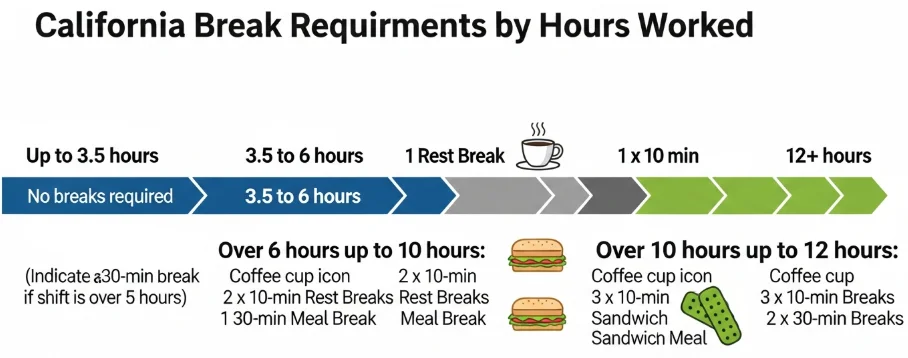
This timeline shows the minimum number of paid rest breaks and unpaid meal breaks an employer must provide based on the total hours worked in a shift.
The core of California’s meal and rest break laws revolves around the distinction between Meal periods and the rest period.
- Meal Periods: These are unpaid, off-duty blocks of time where the employee is relieved of all work duties. They generally must last at least 30 uninterrupted minutes.
- Rest Periods: These are paid, on-the-clock breaks, typically lasting 10 minutes, that count as part of the work period.
These rights apply primarily to non-exempt employees. “Non-exempt” usually refers to hourly workers, though some salaried workers also fall into this category if their duties don’t meet specific executive, administrative, or professional criteria. If you are a non-exempt employee, your entitlement to these breaks depends directly on the number of hours you work in a shift.
Key Laws Governing Breaks
Three main legal pillars support your right to a break:
- California Labor Code § 512: This statute mandates that employers must provide a meal break of at least 30 minutes for employees who work more than five hours a day. A second meal period is required for shifts exceeding 10 hours.
- California Labor Code § 226.7: This law prohibits employers from requiring employees to work during mandated meal or rest periods. Crucially, it establishes the premium pay penalty: if an employer fails to provide a compliant break, they must pay the employee one additional hour of pay at their regular rate of compensation for each day a violation occurs.
- Wage Orders issued by the Industrial Welfare Commission (IWC): These orders provide industry-specific rules (e.g., for manufacturing, housekeeping, or agriculture) regarding working conditions, including Meal and Rest Breaks. The California Supreme Court has repeatedly affirmed that these Wage Orders carry the force of law.
Meal Breaks vs. Rest Breaks Explained
While both are breaks, the rules governing them differ significantly:
- 30-Minute Unpaid Meal Breaks: You are entitled to an unpaid, uninterrupted 30-minute meal break if you work more than 5 hours. The “before the 5th hour” rule is critical here: the break must commence before the end of the fifth hour of work. For example, if you start at 9:00 AM, your lunch must begin no later than 1:59 PM.
- 10-Minute Paid Rest Breaks: You are entitled to a paid 10-minute rest period for every four hours worked, or a “major fraction thereof.” This means if you work a standard 8-hour shift, you generally get two 10-minute rest breaks. Unlike meal breaks, these are paid time, and you should not have to clock out for them.
The Most Common Meal Break Violations by Employers
Meal break violations are among the most frequently litigated employment issues in California. Employers often try to squeeze extra productivity out of workers by shaving minutes off lunch hours or delaying them until it’s convenient for the business. These seemingly small infractions constitute clear Break violations under California law.
Failing to Provide Timely Meal Breaks
Timing is everything under California law. A common violation occurs when an employer pushes a meal break too late into the shift. As mentioned, the meal break must start before the end of the fifth hour of work.
If a restaurant manager asks a server to wait until the “lunch rush” is over, causing the server’s break to start in the sixth hour of their shift, the employer has violated the law. Even if the employee eventually gets a full 30 minutes, the timing violation triggers a penalty. Similarly, routinely cutting a break short, giving an employee only 20 minutes instead of 30, is a direct violation of Labor Code § 512 and constitutes a clear wage and hour violation.
Requiring Employees to Work During Meal Breaks
A “working lunch” is illegal for non-exempt employees unless specific waiver conditions are met (which is rare). Employers violate the law when they expect employees to:
- Eat at their desks while answering phones.
- Monitor a radio or security feed while eating.
- Reply to emails or Slack messages while clocked out for lunch.
If you are not fully relieved of all duties, meaning you are not free to leave the premises or ignore work tasks, you are not on a valid meal break. The California Supreme Court case Murphy v. Kenneth Cole Productions affirmed that breaks must be completely free from employer control to be compliant.
Misusing On-Duty Meal Break Waivers
There is a narrow exception known as an “on-duty meal break,” where an employee eats while working and is paid for that time. However, this is only legal when the nature of the work prevents the employee from being relieved of all duty (e.g., a lone security guard on a night shift) AND there is a written agreement between the parties.
Employers frequently abuse this by forcing employees in standard jobs like receptionists or retail clerks to sign on-duty meal waivers simply to ensure coverage. If the nature of your work allows for someone else to cover you, or for the business to pause, an on-duty meal break waiver may be invalid and illegal. Furthermore, employers cannot coerce you into signing these waivers; you must be able to revoke the agreement at any time.
Common Rest Break and Scheduling Violations
Rest breaks are shorter, but they are just as protected by California’s meal and rest break laws. Because they are paid and don’t involve clocking out, employers often treat them as optional or interruptible, leading to frequent violations of the state’s rest break law.
Denying or Skipping Required Rest Breaks
The most basic violation is simply denying the break. A 2024 survey revealed that this is a pervasive issue, with 58% of California workers reporting they experienced paid rest break violations. Employers often claim that a workplace is “too busy” to spare an employee for 10 minutes. Under California law, business volume is not a valid excuse for denying statutory rights.
If you work a shift from 8:00 AM to 5:00 PM, you are entitled to two 10-minute rest periods. If your supervisor tells you to skip one to finish a project, they are violating the law and owe you premium pay.
Interrupting Rest Breaks With Work Tasks
A rest period must be a period of genuine rest. Violations occur when supervisors interrupt an employee in the break room to ask work-related questions or demand they return to the floor early.
Furthermore, requiring an employee to remain “on-call” during a rest break effectively denies them the break. If you are required to keep your walkie-talkie on and respond to calls during your 10 minutes, you have not been provided a duty-free rest period. Any interruption, no matter how brief, can trigger a violation.
Requiring On-Site Presence Without Compensation
Generally, employees must be free to leave the employer’s premises during their unpaid meal breaks. If an employer requires you to stay in the building, perhaps “just in case” it gets busy, that time legally converts to hours worked and must be paid.
While employers can restrict movement during paid 10-minute rest breaks (e.g., prohibiting you from driving off-site for safety reasons), they cannot restrict you to your immediate workstation. You must be relieved of duty. If you aren’t, the break isn’t valid, and a wage violation has occurred.
Employer Practices That Hide or Enable Break Violations
Sometimes, Break violations aren’t about a specific 30-minute block of time, but rather the systemic practices an employer uses to hide the fact that breaks aren’t happening. These practices are often designed to circumvent labor law entirely.
Misclassifying Employees as Exempt
One of the most insidious ways employers avoid breaking laws is by misclassifying workers as “exempt.” An exempt employee (usually a salaried manager or professional) is not entitled to mandated Meal and Rest Breaks.
However, titles can be deceiving. An “Assistant Manager” who spends 90% of their time stocking shelves, making coffee, or performing the same duties as hourly workers may actually be non-exempt under the law. Misclassification not only denies you breaks but can also lead to unpaid overtime and violations of Minimum Wage laws. If you have been misclassified, your employer likely owes you years of missed breaks and overtime.
Poor or Inaccurate Break Time Record-Keeping
Employers are required to keep accurate records of employee hours. A common illegal tactic is “auto-deducting” meal periods. This happens when a timekeeping system automatically subtracts 30 minutes from an employee’s daily hours for lunch, regardless of whether the employee actually took the break.
If you worked through lunch but the computer says you took a break, you are being underpaid. Similarly, if supervisors alter time cards to make it look like breaks were taken on time when they were actually late, they are falsifying records to avoid penalties, which is a serious violation.
Failing to Pay Premium Wages for Missed Breaks
When an employer fails to provide a compliant meal or rest break, Labor Code § 226.7 requires them to pay premium pay, one extra hour of pay at the employee’s regular rate for each workday that a violation occurs.
Many employers simply ignore this rule. They might apologize for a missed lunch but fail to add the penalty pay to the next paycheck. Failure to pay this premium is a form of wage theft and a direct violation of California labor law.
What Are the Legal Consequences for California Employers?
A lawyer for workplace issues provides sharp teeth to enforce California law. Employers who ignore meal and rest break laws face significant financial liability that can extend far beyond the initial violation.
Penalties and Financial Exposure
The immediate consequence of a violation is the premium pay described above. This can accrue rapidly. If an employee misses lunch three times a week for a year, the employer owes 150+ hours of extra pay.
Beyond that, employers face waiting time penalties. If an employee quits or is fired, and the employer has failed to pay all wages due (including premiums for missed breaks), the employee may be entitled to their daily wage for every day the payment is late, up to 30 days.
Class Actions and PAGA Claims
Break violations are rarely isolated to one employee. Usually, if a company policy is unfair, it affects the whole workforce. This makes Break violations a common trigger for class action lawsuits, where employees band together to recover damages.
Alternatively, employees can file under the Private Attorneys General Act (PAGA). This allows an aggrieved employee to sue on behalf of the state of California for labor code violations, resulting in substantial civil penalties for the employer. Both class actions and PAGA claims have been shaped by landmark California Supreme Court decisions.
Government Enforcement in California
Agencies like the California Labor Commissioner and the Division of Labor Standards Enforcement (DLSE) actively investigate these claims. The Labor Commissioner has the power to audit employer records, issue citations, and order the payment of back wages and penalties, providing a crucial avenue for employees to seek justice without filing a lawsuit.
What Employees Can Do If Their Break Rights Are Violated
If you recognize any of the violations listed above in your own workplace, you have options. It is important to act strategically to protect your claim and recover the wages you are owed.
Documenting Break Violations
Evidence is key. Start keeping a personal log of your hours. Record every time you:
- They are denied a break.
- We are forced to take a late lunch (after the 5th hour).
- They are interrupted during a break.
- Notice your pay stub doesn’t reflect premium pay for missed breaks.
Save emails, text messages, or schedules that prove these violations. Witness statements from coworkers can also be vital in corroborating your story and strengthening your case before the Labor Commissioner.
Filing a Wage Claim or Complaint
You can file a wage claim directly with the DLSE. The process involves submitting a complaint, attending a settlement conference, and potentially going to a hearing. Be aware that there are time limits (statutes of limitations) for filing these claims, typically three years for statutory violations, or up to four years for unfair business practices.
When to Contact a Work Break Violations Lawyer in Los Angeles
While you can file a state claim on your own, the process can be complex and intimidating, especially if your employer has legal representation. If you have suffered significant wage theft or if the issue affects many coworkers in Los Angeles or elsewhere in California, it is wise to consult with an employment lawyer.
A specialized Work Break Violations Lawyer Los Angeles can evaluate your case to see if you are owed premium pay, waiting time penalties, or interest. Most employment lawyers and labor law specialists work on a contingency basis, meaning you don’t pay unless they win your case. Seeking professional counsel can ensure you don’t leave money on the table.
Frequently Asked Questions
What is considered a violation of the California break law?
A violation occurs if an employer fails to provide a timely, uninterrupted, 30-minute unpaid meal break for shifts over 5 hours, or a 10-minute paid rest break for every 4 hours worked. Interrupting a break, forcing a “working lunch,” or providing breaks too late in the shift also count as Break violations that trigger penalties.
What are the rules for breaks at work in California?
Under California’s meal and rest break laws, non-exempt employees get a 30-minute unpaid meal break if working more than 5 hours (and a second if working more than 10). They also get a 10-minute paid rest break for every 4 hours worked or major fraction thereof.
What is the 7-minute rule in California?
This refers to rounding practices for timekeeping. Employers often round time to the nearest quarter hour (15 minutes). If you clock in at 8:07, it rounds to 8:00. If you clock in at 8:08, it rounds to 8:15. However, this practice is only legal if it is neutral and doesn’t systematically underpay employees over time. If rounding always favors the employer, it is illegal.
What if my employer denies my lunch break?
You are entitled to one hour of pay at your regular rate for each day a meal break is denied or non-compliant. You should document the denial and check your pay stub to see if the premium pay was paid. If not, you can file a wage claim to recover it.
Are new mothers entitled to lactation breaks?
Yes. California law requires employers to provide a reasonable amount of break time for an employee to express breast milk for an infant child. This can run concurrently with rest breaks, but if it takes longer, the extra time can be unpaid. Employers must also provide a private room (not a bathroom).
Can I sue my employer for missed breaks?
Yes. You can file a lawsuit, a PAGA claim, or a wage claim with the Labor Commissioner to recover unpaid premium wages and penalties. Because employment laws are complex, consulting with an experienced employment attorney is often the best first step to understand your options and the value of your claim.

 Oliver Johnson is LawScroller’s Senior Legal Correspondent specializing in civil litigation, class actions, and consumer lawsuit coverage. He breaks down complex settlements and court decisions into clear, practical guidance for readers.